
There’s a particular loneliness in being the only person in a room willing to say what everyone else came ready to oppose, especially when that room is your own community. Last month, I wrote about the advocates who march head first into these situations, and what it takes to hold your ground, turn the tide, and make progress.
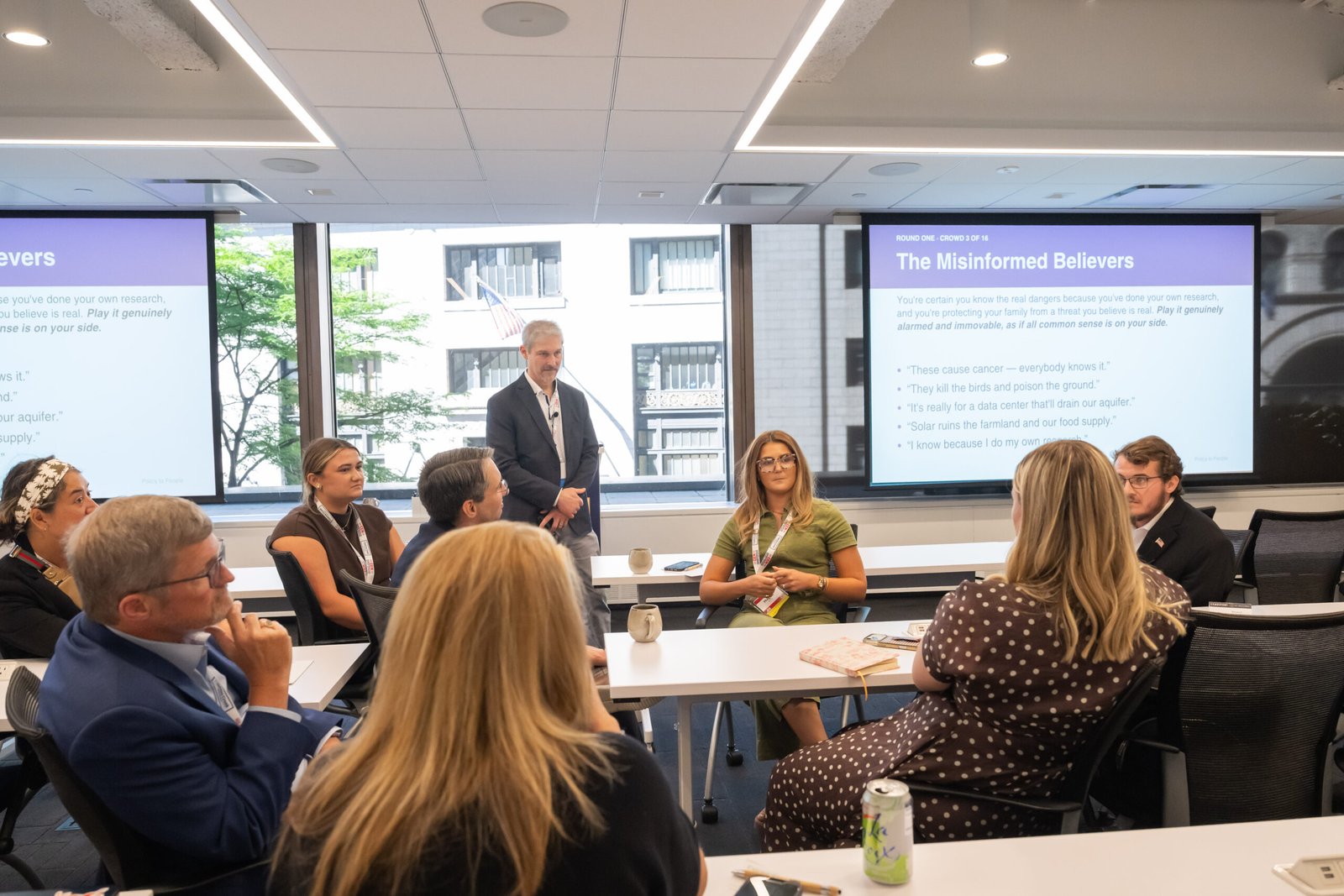
That was the starting point for “Policy to People: Communicating Energy Effectively,” a role-play session I facilitated at the National Conservative Energy Summit in Boston with attendees from governments, nonprofits, businesses, and academia.
The workshop was built on the premise that the chances of winning over raised eyebrows or disarming defensive glares from shareholders, commissioners, neighbors, or even family members can only increase when these moments are practiced as a group ahead of time.
The session put each person through the uncomfortable challenge of making their case to skeptical and adversarial crowds, which let them experience getting knocked on their heels, recovering their footing, turning the argument, analyzing what happened, and trying again.
We started with all participants writing down a handful of their own personal experiences advocating for clean energy, and then splitting into groups. Each group had a “hot seat” that faced away from a screen, where slides describing the crowd characters were projected behind the advocate.
Each slide provided role-playing guidance to the members of the different crowds, offering lines a person might say to challenge the advocate, along with notes that a director might give an actor on how to play the role. Participants could work from the suggestions on screen, but were also encouraged to improvise and inhabit the role as fully as they could. Among the sixteen crowd descriptions were Misinformed Believers, Betrayed Neighbors, and Skeptical Commissioners.
For the advocate in the hot seat, a brief crowd description without the suggested lines and directorial notes was read aloud, just to give them a basic sense of the audience they would be facing. For the next three minutes, advocates made their cases while everyone else played the crowd, and in some cases, the unruly mob. All participants rotated through the hot seat so everyone had a chance to break a sweat.
We closed by analyzing the moments that felt hardest, what people noticed about themselves under pressure, what they hadn’t previously considered about their audience, and what they’d do differently next time.
It was more instructional for the less experienced participants, more cathartic for those who had taken their fair share of scalding in real hot seats over the years, and lots of fun for everyone – a refreshing change for anyone whose eyes might glaze over when hearing “let’s bring up our next panel” on the third day of a conference with one keynote, plenary, and breakout session after another.
As one member of the NCES executive team put it when reflecting on the experience, participants “didn’t just hear about tough conversations, they lived them, and got better in real time.”
To be sure, one role-play or simulation exercise won’t produce mastery, but going through the motions, without paying the sometimes damaging costs of getting it wrong in front of a live crowd, can only build the skills and muscle memory needed to increase the chances of success for when things get real.